The Middle Way
Despite my essay on resolutions, I love looking back on the last year and forward to the next. And when I did, I realized there were many things I wanted to do this year, begging the question: how do you accomplish the pursuits you choose? Sam has an impeccable ability to say he wants to do something, and then doing it, following all the SMART goal aspects intuitively. He knows what motivates him and sets goals along the way to check progress and keep him on track. As a massage client said when I described him in relation to my (and her) brain, "how nice that must be to have such executive function." We laughed, but it's stuck with me. As I've learned more about the way my brain works, I started thinking about how challenging this time of year is. The world, including much of how our coaching is structured, is well designed for people like Sam who like and do well structure. But what about the rest of us?
The standard method of setting a goal as you would climb a mountain and make progressive steps along the way is too clean of a metaphor; or maybe it’s the perfect metaphor since anyone who has climbed a mountain will tell you, it’s no more linear than attaining any large goal. There are setbacks, unexpected challenges, and if it’s truly your mountain, you’ll reach your edge and question your intentions. You’ll also need to adapt, but some people’s natural flexibility makes it nearly impossible to see the direct line toward the top of the mountain. For those of us who see a mountain but can’t imagine how to possibly stay on the trail, no matter where it goes, setting goals can be very intimidating. An exciting challenge soon becomes an expectation with pressure to perform, even if no one is watching.
Pema Chodron’s book I referenced in my last piece, The Wisdom of No Escape, truly could be a training book (and I suppose it is in the sense of training to be a more aware human) offers so much guidance for any goal. She writes about being “not too tight and not too loose,” which really resonated with me. When I thought about how I would attain any of the goals I want this year, I thought about my natural tendencies. I don’t like a lot of structure. I like to have options. I don’t want to feel the pressure of anyone expecting anything from me. It stresses my sister-in-law and potentially my husband out, but the comfort they find in planning creates low grade anxiety that builds to complete overwhelm and giving up for me. You could call this scattered, or disorganized (and I’m sure many have) but reading Chodron’s book helped me reframe it as “loose”. Her own meditation practice is less structured than many, so she sometimes practices in a more structured or rigid way to create balance.
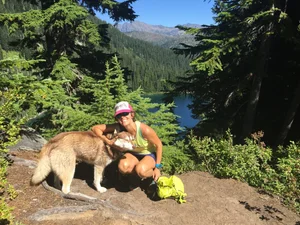
If left to my own devices, I run (or ski or bike) in the woods or alpine with my dog, at an effort I can go all day. Every so often I’ll add in some intensity, but I care much more about being able to get outside daily than risk getting injured or sick. That’s all well and good, but I also get frustrated when I don’t make much progress. So where’s the middle way? She says “the basic guideline is to see what’s too tight for you and what’s too loose for you, and you’ll discover [the middle way].”

Stella doesn’t need structure, she just needs to run.
For the last twenty years I've tried following plans but can’t stick to them for longer than about eight weeks. I would feel bad that I got off track one day, then be overwhelmed and throw up my arms in defeat. I’ve coached hundreds of people over the course of those twenty years who followed the plans I created and completed their goals. I felt like a failure that I couldn't "get my sh*t together" to do the same. Then, a couple of years ago I read the book Scattered Minds by Gabor Mate, about attention deficit disorder (ADD). I had never considered that I might have ADD. Sure, I liked to have a million things going on at once, and sure, I can't keep tasks straight, and have a terrible sense of time, but doesn’t everyone? I thought I couldn’t have it because I like quiet, can read books for hours at a time, and I hate fidgeting-my own and anyone else’s around me. Then I read an anecdote in the book about a man who took his dog on a walk daily. His dog, however, would not go to the door until the owner came back several times. The dog knew that the first (or second) time through the door would not be the last.
Every time I leave the house, no matter how many lists I make for myself, I come back for something I forgot. Many middle-aged women talk about ADD so I discounted it, but as the years went on, it kept coming around. Then our eight-year-old was the lead role in our local production of the Little Prince. She had a book of lines to memorize, and we couldn't get her to practice them. When the off-book rehearsal approached, she had a stomachache and didn't want to go. We knew about stomach aches that occur at times like these. She melted down spectacularly, the poor girl, completely overwhelmed. She felt like a failure. She felt the pressure of the entire play and anytime anyone said anything about her role, I saw the split-second panic on her face, followed by a slight smile and polite nod or “thanks”. I caught it all because I recognized it in myself: she is me. I thought.

Who says I get distracted easily…? But look how beautiful this hoar frost is!
I feel overwhelmed by big tasks, even for projects (or races) I am excited about. But I also thrive on deadlines and am only interested in big undertakings and challenges. Where’s the middle way? Now I can catch myself and recognize when I’m doing it. Just yesterday I went down a spiral about the race I signed up for, wondering what the point was when I couldn’t train that day and am a little behind where I want to be right now. But action is the best way to get out of one’s head, and I ran today, adding some structure to the workout (and day) and feel back on track. People talk about little wins a lot, but I can’t emphasize how helpful the little wins are. Little successes build on each other and just like with building fitness, if you stack enough of them together, you’ll have a whole pile of them and the big thing won’t feel so big anymore.
Last Friday I planned to do a long run, after doing one Wednesday. In most training plans you do one long run per week, but for 100s there's really no set way, and maybe that's why I like them. There are the component parts, but at the end of the day, continuing to keep moving through the night, through discomfort, and simply keeping going, is much more mental than physical. So I'm approaching my training differently now. I ran fifteen miles Wednesday, seven miles with some intensity yesterday, and I went out today for another few hours. But something felt off in my left hip. There wasn't anything super painful, but I was aware of it. A different part of the same hip hurt after my run on Wednesday. I sat on the hearth by the stove to warm up and when I stood to make a coffee, a piercing pain shot from the inside of my pelvis. I've had this pain before, and it comes just as suddenly and randomly, about twice per year. It’s reminiscent of labor and the only thing I can imagine is that one of my sacral ligaments gets pulled in an odd way. My Wednesday run was on the road, so maybe that much continual running and impact triggered something. The pain subsided and I didn't think about it again. I felt strong and good yesterday, but I worked on my feet from 7:45 am until 5pm, then came home, had a snack, and headed out for another trot. This morning my body felt tired, but that's good ultra training I thought. I ate breakfast and left. I hiked a lot since I haven't done much of that during this low snow winter, so uphills were fine, but with any downhill running, I was aware of the hip. After two hours I came home, defeated.
My first thought was I did it again: I failed at what I was out to do. I wanted to get at least three hours, but called it at two. But then I paused. Who is telling me this is a failure? I did a long run two days ago. I've increased my overall volume a lot, so why isn't adjusting so I can run tomorrow a good thing? Who says I have to do anything?
I thought about all the books and newsletters I read on writing from authors I admire. Everyone has their own process! No one says "this is the way to write a book. "They might say "this is how I write a book" but even that is more often framed "how I wrote this particular book."
Like parenting, what works one day doesn't work the next, or as anyone who has more than one child knows, what worked for one child doesn't always (or ever) work for another. And you, the parent are different every day, and certainly after several years.
My long run didn’t look like most long runs do, but maybe this was the middle way.